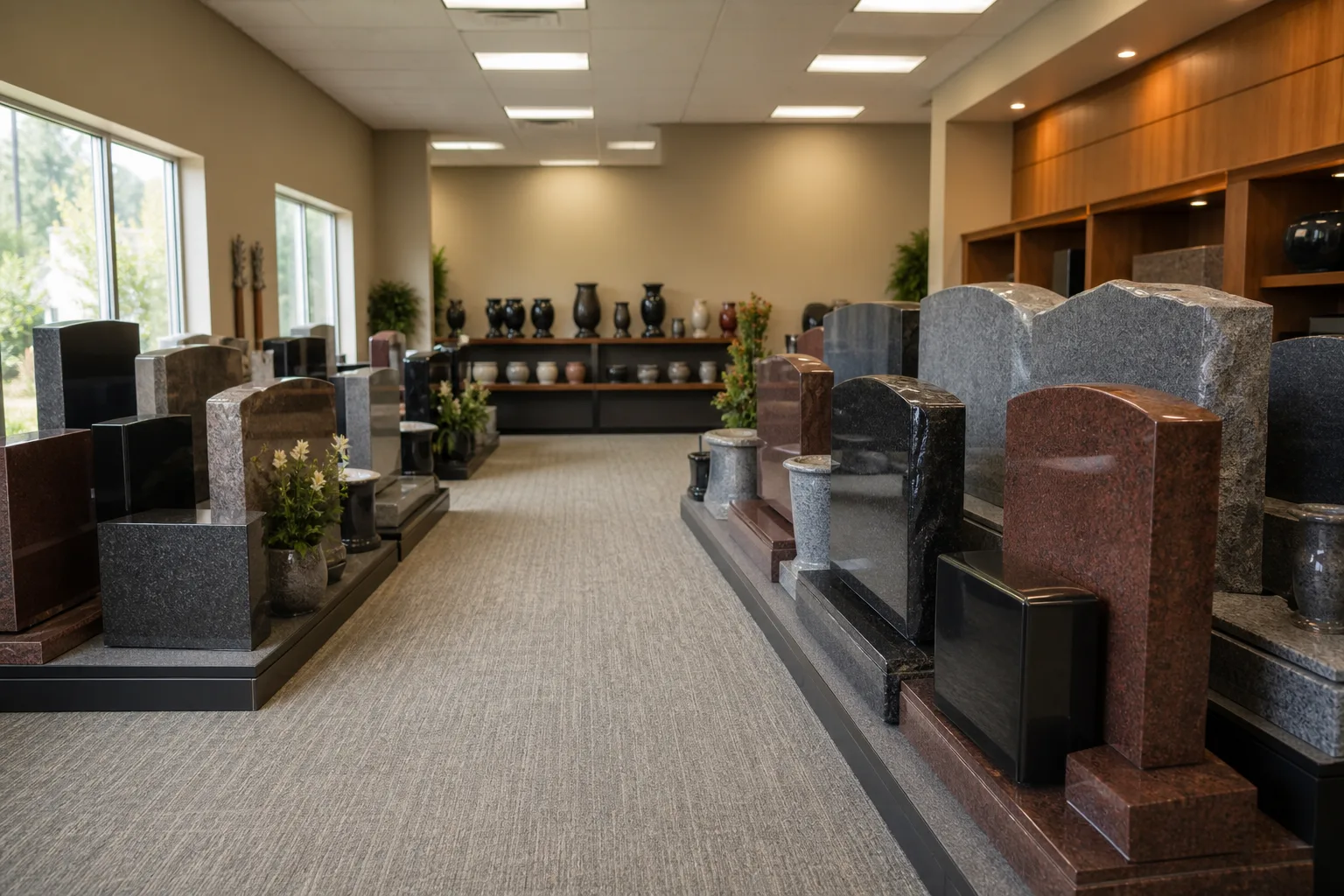
One family's work of pricing and ordering a cemetery memorial, written down so the next person can compare quotes without guessing at the terms.
Two quotes for what looks like the same memorial can differ by a factor of two, and the reason is almost never that one company is gouging you. It is that the quotes are built from different parts, drawn on different lines, with some costs folded in and others left for you to discover later at the cemetery office. Once you can see the five components underneath the total, the comparison stops being a guess. Stone, lettering, foundation, freight, and the cemetery's own charges. Every quote contains all five, whether or not it names them.
The stone: size, color, and how much of it is finished
Granite is priced by volume and by quarry, and those two factors move independently. A flat marker twenty-four inches by twelve by four contains a fraction of the granite in an upright twenty-four by six by thirty-six with a base, so the raw material line differs enormously before anyone talks about color. Then color: the common gray and black granites quarried in quantity in the United States and abroad sit at the bottom of the range, while reds, blues, and figured stones cost more because fewer blocks yield usable slabs. Finish matters too. A stone polished on all faces costs more to produce than one polished on the front only, with the sides and back left sawn or rock-pitched.
The lettering, and why the second inscription costs more than the first
Engraving is usually quoted as a package for a set amount of standard text, then priced per character or per line beyond it. Sandblasted lettering cut in the shop, before the stone ever leaves, is cheap on a per-letter basis because the stone is flat on a table and the stencil work is routine. The same lettering cut in the cemetery, after the memorial is set, costs several times more, since a crew has to travel, tent or shield the work, and cut a vertical surface in the field. That is why the date of death added years later for a surviving spouse is a separate, substantial line, and why it is worth asking what it will cost now rather than assuming.
Artwork follows its own logic. A standard rose, cross, or praying hands from the supplier's existing library adds little, because the stencil already exists. A custom drawing, a portrait etched by laser or by hand, or a scene wrapped across a die adds design hours before any stone is touched. When you price a grave marker with a photographic image, you are buying an artist's time as much as anything else, and the quote should say how many revisions of the proof are included.
Foundation and setting, the line most often left out
Something has to hold the memorial up, and that something is a poured concrete foundation or a precast base, sized to the stone and to the cemetery's specification for depth and reinforcement. Some cemeteries pour their own foundations and bill you directly, at a rate per square foot or per linear inch of memorial length. Others allow the monument company to pour, in which case the cost sits inside the dealer's quote. A few require a licensed contractor and inspection. This single difference explains a large share of the gap between two otherwise similar quotes, so ask plainly which party is pouring and whether the figure in front of you includes it.
Setting is the related labor: transporting the finished stone to the grave, positioning it on the foundation, and bedding it with adhesive or mortar. On a flat marker in an open lawn section this is a short job. On a heavy upright in an older section with narrow drives, mature trees, and soft ground, it may take a crew, a boom truck, and plywood matting to protect the turf.
Freight, cemetery fees, and the charges nobody quotes first
Granite is heavy and travels badly, so freight from the quarry or fabricator is real money and it scales with weight and distance. A dealer who buys finished monuments from a domestic wholesaler and one who imports blanks and finishes locally will show that cost in different places, sometimes inside the stone price, sometimes as a separate line. Then the cemetery adds its own: a memorial permit or installation fee, a design approval charge, occasionally a perpetual care assessment tied to the memorial rather than the plot. Ask the cemetery office for its written schedule before you sign anything with a dealer.
Sales tax applies in most states to the monument as tangible goods, and the treatment of the installation labor varies by state. The Federal Trade Commission is responsible for the rule governing price disclosure by funeral providers, and while that rule aims at funeral homes rather than monument dealers, the habit it encourages is the right one here: ask for an itemized written price list and keep it.
Which lines actually move between suppliers
Stone cost varies less than people expect, because every dealer buys from the same relatively small set of quarries and wholesalers. Engraving varies more, since shop capacity and design labor differ. Foundation and setting vary most of all, because they depend on who is allowed to do the work at that particular cemetery and how the two parties split it. Cemetery fees do not vary at all between dealers; they are fixed by the cemetery. So when a quote is unusually low, look at the foundation line first, then at how many characters of lettering are included.
Get both quotes onto one sheet of paper with the same five headings, fill in a number for each, and write "not included" where the quote is silent. The blanks are the questions worth asking.